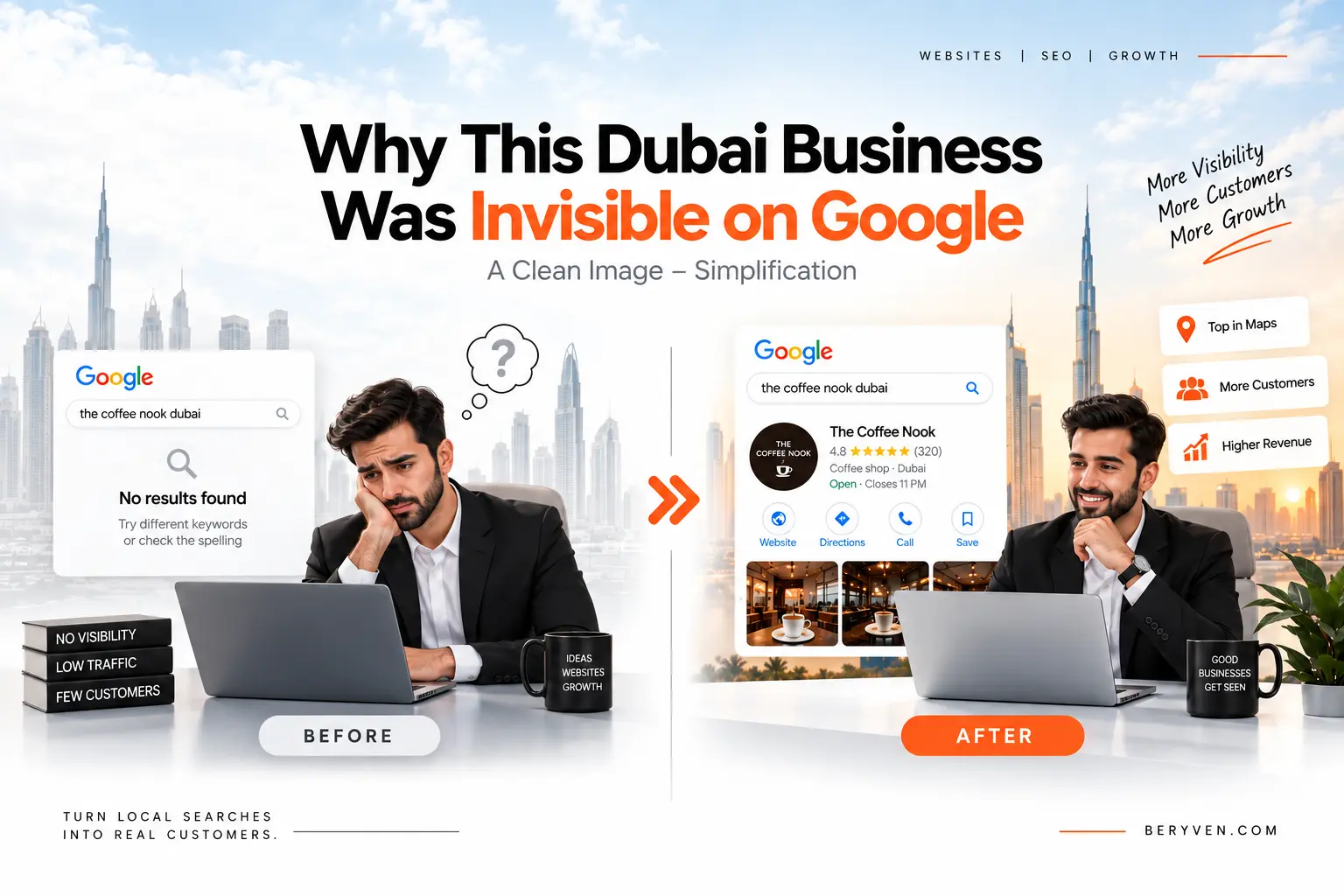
Most businesses in Dubai come to us after the same experience: they invested in a website, waited, watched their Google Search Console numbers sit flat for months and eventually started wondering whether SEO actually works at all. This client was no different.
A used appliances business operating across Dubai and Abu Dhabi - real services, real customers, genuine demand in the market - but completely invisible on Google. Not ranking on page 2 or page 3. Essentially not ranking at all.
The reason had nothing to do with their product or their prices. It had everything to do with what was underneath their website - the structure, the architecture, the internal links and the content. Google couldn't understand what they sold, where they operated or who they were meant to serve. And when Google can't understand a website it doesn't rank it.
This is the documented account of exactly what we found, what we changed and what happened to their numbers afterward.
📉 Before Beryven's Work
24
Organic Clicks
3,790
Impressions
0.6%
Click-Through Rate
12.9
Average Position
📈 After Beryven's Work
444
Organic Clicks
21,800
Impressions
2.0%
Click-Through Rate
10.8
Average Position
That is a 1,750% increase in organic clicks and a 475% increase in impressions in just three months - without paid advertising, without buying backlinks and without any shortcuts that put the site at future risk.
The Problem: A Website Google Couldn't Understand
When this client first came to us - their website consisted of a single homepage. That's it. No service pages. No location-specific pages. No blog. No internal links connecting anything to anything else.
From Google's perspective this site was almost impossible to categorize. It had one page that mentioned appliances and Dubai in a general way - which told Google nothing specific about what the business actually sold, where it operated or who it was meant to serve. The result was exactly what you'd expect: near-zero organic visibility and 24 clicks per month from a tiny handful of random searches.
This is more common than most Dubai business owners realize. Many Dubai businesses rank on page 2-3 for high-intent keywords not because their service is inferior but because their website gives Google insufficient structure to confidently rank them for the queries that matter. The fix isn't always more content - it's better architecture first.
Building a Website Structure Google Could Actually Read
The first decision we made was also the most important one: before writing a single word of new content we designed the entire website architecture from scratch based on what real customers in Dubai and Abu Dhabi actually search for.
Every service the client offered received its own dedicated landing page. Every city they operated in received its own location-specific pages - not a generic 'We serve Dubai and Abu Dhabi' line buried in the footer but actual standalone pages built around location-paired keywords with real content.
When someone in Dubai searches 'used washing machine Dubai,' Google is looking for a page that specifically addresses that query - not a homepage that mentions washing machines somewhere in its text. Separate, dedicated pages for each service-location combination gave Google exactly the specificity it needed to start matching this site to high-intent local searches.
Internal Linking: The Phase Where Most SEO Stalls
Once the pages were live, we implemented a silo-based internal linking structure. Related pages were connected to each other in a way that reinforced topical relationships: the Dubai washing machine page linked to the Abu Dhabi washing machine page, refrigerator pages linked to other refrigerator-related pages and category pages tied together the individual product pages sitting beneath them.
This does two things simultaneously. First, it helps Google understand how the content on the site relates to itself - which strengthens the topical authority signals for the entire cluster. Second, it passes authority from pages that Google already trusts to pages that are newer or less established.
The problem we encountered here is the same problem that quietly derails internal linking strategies across most Dubai business websites: the silo structure wasn't enough on its own. When we reviewed Google Search Console after the initial pages went live, several important pages were still not being indexed. The reason was insufficient internal authority - the pages existed, but Google had no strong reason to crawl them because too few established pages on the site were pointing to them with contextually relevant links.
The Homepage Audit Finding That Changed Everything
During a later technical audit, we found one more critical issue that had been silently limiting the site's performance: the homepage had almost no internal links pointing outward to service pages.
This happens frequently on sites where the homepage was built first and the service pages were added afterward. Nobody goes back to update the homepage with links to the new content, so the homepage - which typically holds the most authority of any page on the site - distributes almost none of that authority to the pages that actually need it to rank.
We corrected this by adding carefully chosen contextual links from the homepage to the most important service pages, and by using those homepage links to give additional support to the pages still working to get indexed. The improvement in crawl coverage was measurable in Search Console within weeks.
The Results: What Happens When SEO Is Done Strategically
| Metric | Before | After | Change |
|---|---|---|---|
| Organic Clicks | 24 | 444 | +1,750% |
| Impressions | 3,790 | 21,800 | +475% |
| CTR | 0.6% | 2.0% | 3x improvement |
| Average Position | 12.9 | 10.8 | Toward page 1 |
The click-through rate improvement is worth pausing on. Going from 0.6% to 2.0% CTR means the pages showing up in search results had become significantly more relevant to what searchers were actually looking for - which is the clearest signal that the content and page structure were genuinely matching real search intent, not just appearing for tangentially related queries.
What This Means for Your Business
The used appliances business in this case study is not unusual. The same structural problems - a weak website architecture, missing location pages, poor internal linking, unindexed service pages, and a homepage that doesn't distribute authority - exist on the majority of business websites we audit across Dubai, Sharjah and Abu Dhabi.
The specific industry doesn't matter. The same framework applies to a clinic in Sharjah, a law firm in Abu Dhabi, a restaurant in Business Bay or a logistics company in Jebel Ali. Within 4-6 months, a well-executed SEO campaign in Dubai typically delivers meaningful organic traffic growth - and within 12 months, can produce 3-5x the organic traffic of the starting point, with a significantly lower cost per lead than any paid channel.
What changes the outcome isn't the industry - it's whether the SEO work is built on a real strategic foundation or on shortcuts that produce short-term movement and long-term risk.
Actionable Takeaways for Dubai Business Owners
- •A homepage-only website cannot rank for specific service or location searches - each service and city combination needs its own dedicated page
- •Internal linking is not optional or decorative - it is one of the primary mechanisms by which Google understands your site and distributes authority across it
- •If pages on your site aren't being indexed, the cause is usually insufficient internal authority, not a technical indexing error
- •Image alt text is consistently underutilized and consistently costs businesses organic visibility they should be earning
- •Content built around real buyer questions outperforms keyword-stuffed content at every stage of Google's algorithm updates
If Your Website Is Getting Impressions but Not Clicks
If your website is getting impressions but not clicks, ranking on page 2 or 3 but never breaking through, or simply not showing up at all for the searches that matter - the cause is almost always findable and fixable.
More Blogs