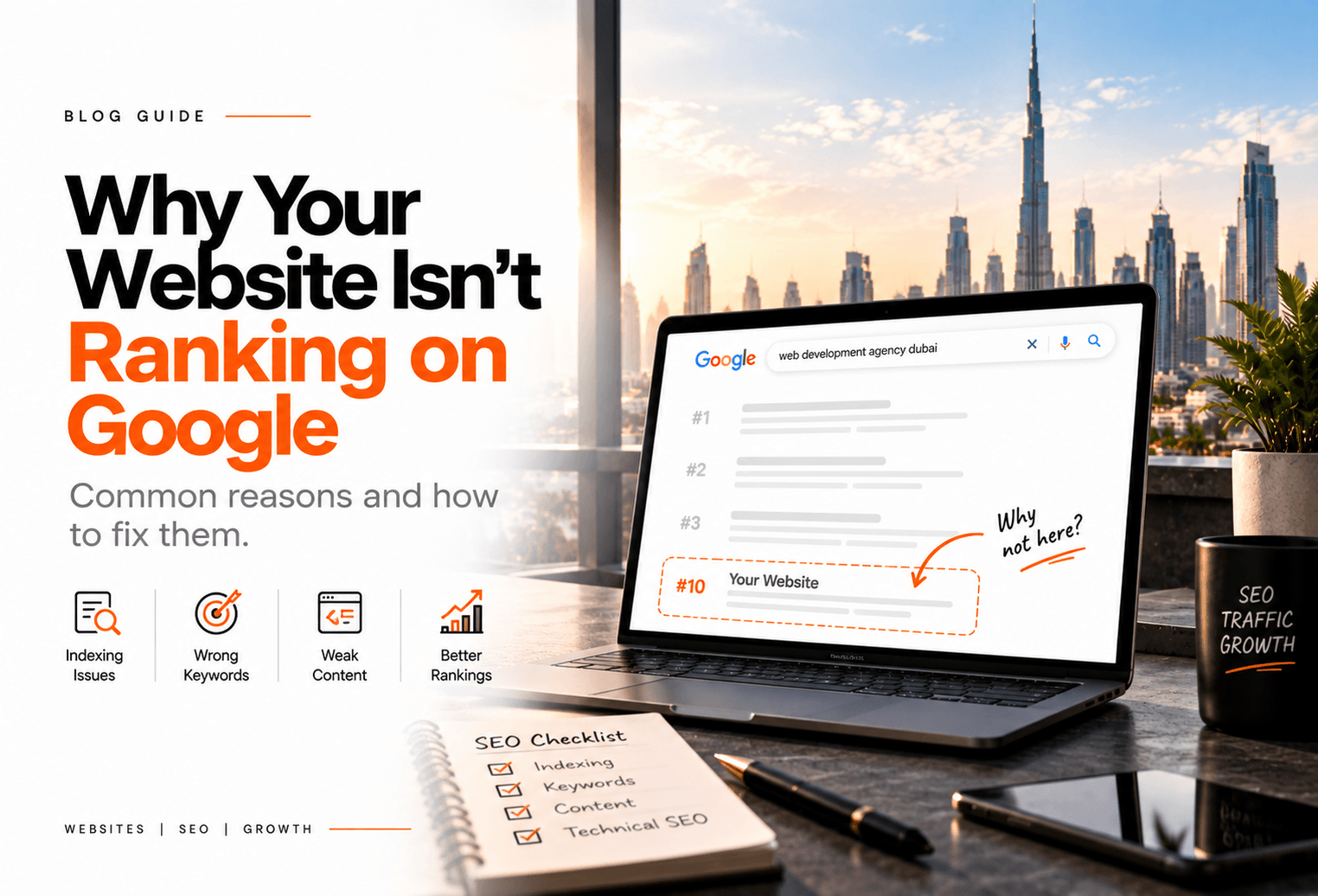
You published the website. Added your services. Wrote a few blog posts. And expected Google to start sending visitors.
But weeks or months later, your website is still nowhere near the searches that matter. Many Dubai businesses experience this exact situation. If you're wondering why your website isn't ranking on Google, the answer usually isn't one single SEO mistake.
Your page may not be indexed properly. Your content may not match search intent. Your website may target the wrong keywords. Your competitors may have stronger topical relevance or authority. Or your website may simply not give Google enough useful information to understand why it should appear for a particular search.
Google's ranking systems evaluate many signals and aim to show helpful, relevant results rather than pages created primarily to manipulate rankings. The good news is that you can diagnose the problem systematically.
First: Is Your Website Actually Indexed?
Before changing your content or buying backlinks, check whether Google has indexed the page. Indexing and ranking are two different things. A page can exist on your website without appearing in Google's index. And a page can be indexed without ranking well for the search terms you care about.
Start with Google Search Console. Check: URL Inspection, Indexing status, Page indexing report, Sitemaps, Manual actions, Search performance. Google specifically recommends Search Console for monitoring search performance and checking whether pages can be indexed. If an important service page isn't indexed, ranking optimization is not your first problem. Fix indexing first.
1. You're Targeting the Wrong Keywords
One of the most common reasons a website isn't ranking on Google is that it is targeting keywords that don't match the business or the page.
For example, a Dubai web development agency might create content around "website design ideas" but its actual commercial goal is to attract searches such as "web development in Dubai". These are not the same search intent. The first is largely informational. The second has much stronger commercial intent.
Your keyword strategy should connect: Search → Intent → Page → Business Offer. If those four don't match, ranking for a keyword may not generate meaningful business anyway.
2. Your Page Doesn't Match Search Intent
Even if you've chosen a relevant keyword, your page may still fail because it doesn't answer what the searcher actually wants.
Consider: "Website development cost in Dubai". Someone searching this probably wants pricing information, cost factors or a buying guide. If your page only says "We build premium websites. Contact us." you haven't really answered the query.
Google's guidance emphasizes creating useful, people-first content that leaves users with enough information to accomplish their goal. Before optimizing a page, ask: What would someone expect to find after searching this phrase? Then make sure your page actually provides it.
3. Your Content Is Too Thin
A page doesn't need to be extremely long to rank. Google explicitly says there is no preferred word count that guarantees better rankings. But thin content can still be a problem when it fails to answer the user's question properly.
For example, a service page with only a headline, two short paragraphs, a generic service description and "Contact us" may not give visitors enough information to understand the service.
A useful page should explain: What the service is, Who it is for, What problem it solves, What is included, How the process works, Important considerations, Common questions, What the visitor should do next. The goal isn't to make the page longer. The goal is to make it complete enough for its purpose.
4. Your Website Doesn't Demonstrate Enough Relevance
Google needs to understand what your website and individual pages are about. If a website has random content covering branding, web development, social media, digital marketing, graphic design, SEO and business advice without a clear relationship between those topics, it becomes harder to establish a strong topical focus.
Google's current guidance asks whether a site has a primary purpose or focus and whether its content demonstrates relevant knowledge and depth. For a business like Beryven, a clearer focus around Web Development and Local SEO creates a more coherent content ecosystem.
That doesn't guarantee rankings. But it creates a much clearer strategic foundation.
5. Your Service Pages Are Not Strong Enough
Your homepage should not be expected to rank for everything. If you offer several services, each important service should have a page designed around its own intent.
For example: Homepage "Web Development & Local SEO Agency in Dubai", Service page "Web Development Agency in Dubai", Service page "Local SEO Agency in Dubai". The service page can then go deeper into: The problem, The service, Process, Deliverables, Use cases, FAQs, Trust, Conversion.
This gives Google a much clearer page to associate with a specific commercial search.
6. Your Website Structure Is Weak
SEO isn't only about individual pages. Google needs to discover and understand the relationships between your pages.
A simple structure might look like: Home → Web Development → Local SEO → Web Development in Dubai → Local SEO in Dubai → Supporting Blog Content. Your internal links should help users and search engines move between related content.
For example, an article about website development cost in Dubai can naturally link to your web development service. An article about local search can link to your Local SEO service. This creates a logical relationship between informational content and commercial pages.
7. You Have Very Little Internal Linking
A page that receives no meaningful internal links can be harder to discover and understand within the context of your website.
Internal links can help: Users discover related information, Search engines find pages, Establish relationships between topics, Guide visitors toward important service pages. But don't add links simply to increase the number of links. Use descriptive, relevant anchor text and link where the destination genuinely helps the reader.
8. Your Website Is New and Has Limited Authority
A new website can have excellent content and still struggle against established competitors. Why? Because search results are competitive. If you're trying to rank for a commercial query where established websites already have strong content, relevant links, brand recognition and years of accumulated signals, publishing one page won't necessarily move you to the top.
This doesn't mean you should buy hundreds of backlinks. Instead, build authority naturally through: Useful content, Relevant mentions, Digital PR, Partnerships, Industry resources, Genuine citations, Strong service pages, Valuable original information. Authority should support relevance rather than replace it.
9. Your Content Doesn't Add Anything New
Simply rewriting the same information already available on ten competing pages isn't a strong content strategy. Google's people-first guidance encourages original information, research, analysis or substantial value rather than content that simply summarizes what others have already said.
Ask: "What does this page give the reader that the other results don't?" That could be: A practical framework, Original examples, A useful checklist, First-hand experience, Local market context, A comparison table, A process, Real implementation considerations. This is where expertise becomes valuable.
10. Your Technical SEO Has Problems
Sometimes the problem isn't your content. It is the website itself. Check for: Noindex directives, Incorrect canonical tags, Robots.txt problems, Broken internal links, Redirect issues, Duplicate URLs, Poor URL structure, XML sitemap problems, JavaScript rendering issues, Crawl accessibility, Security problems.
If Google can't properly access, interpret or index a page, content optimization won't solve the underlying technical problem. This is why a technical SEO audit should come before randomly rewriting pages.
11. Your Website Is Slow or Difficult to Use
Performance isn't the only ranking factor, but page experience still matters. Google recommends looking at the overall experience of your pages, including mobile usability, security and Core Web Vitals. It also states that good Core Web Vitals alone do not guarantee top rankings.
Check: Mobile responsiveness, Loading performance, Core Web Vitals, Layout stability, Intrusive pop-ups, HTTPS, Navigation, Readability. Don't optimize a website for a perfect score while ignoring the actual visitor experience. The goal is a website that is fast, accessible and useful.
12. Your Pages Are Competing With Each Other
This is especially common when businesses create multiple pages targeting almost the same keyword. For example: "Web Development Dubai", "Website Development Dubai", "Website Development Company Dubai", "Web Development Services Dubai". If all four pages offer almost identical information, creating more URLs may not create more ranking opportunities.
Determine: Which page should own this search intent? Then make that page the strongest and use supporting content to build topical relevance around it. Not every keyword variation needs its own page.
13. You're Changing the Website Too Often
If a page isn't ranking after a few weeks, some businesses immediately: Change the title, Rewrite the H1, Replace the content, Change the URL, Publish another article, Delete the page, Change the keywords. Then they repeat the process.
This makes it difficult to understand what actually worked. SEO needs diagnosis and controlled improvement. If a page is already receiving impressions, examine its queries and positions before replacing everything.
Search Console data can tell you whether the page is appearing for the wrong queries, ranking just outside the top results or failing to gain visibility altogether.
A Simple Ranking Diagnosis Framework
Before making changes, classify the problem:
| Problem | What to check first |
|---|---|
| Page doesn't appear at all | Indexing and technical SEO |
| Page gets impressions but few clicks | Search visibility and SERP presentation |
| Page ranks for wrong keywords | Search intent and content relevance |
| Page ranks around positions 20–50 | Content depth, relevance, internal links and authority |
| Page ranks but doesn't convert | UX, messaging and CTAs |
| Several pages target the same intent | Keyword mapping and site architecture |
| Rankings dropped | Search Console data, content quality and technical changes |
This prevents you from treating every ranking problem as a backlink problem.
What Should You Do If Your Website Isn't Ranking?
Follow this order:
- •Step 1: Check indexing — Make sure important pages can be crawled and indexed
- •Step 2: Review Search Console — Identify which queries generate impressions and where your pages currently appear
- •Step 3: Map search intent — Make sure each important keyword has the right type of page
- •Step 4: Improve the page — Strengthen the content, structure, examples, UX and conversion path
- •Step 5: Improve internal linking — Connect related pages logically
- •Step 6: Fix technical problems — Address crawl, indexing, performance and mobile issues
- •Step 7: Build relevant authority — Earn relevant mentions and links where appropriate
- •Step 8: Measure again — Don't judge success only by one keyword. Look at visibility, impressions, clicks, rankings and ultimately qualified traffic and enquiries
Don't Start With "I Need More Backlinks"
Backlinks can matter. But they're not the first answer to every SEO problem. If your page isn't indexed, backlinks won't solve the indexing issue. If your page targets the wrong intent, more authority won't make the content more relevant. If your website has weak service pages, building links to the wrong page may simply strengthen the wrong asset.
The better approach is: Technical Foundation → Search Intent → Content → Site Structure → Authority → Conversion. Fix the foundation before adding more weight.
When Should You Get an SEO Audit?
An SEO audit can be useful when you know the website should be visible but can't identify the bottleneck. Consider an audit if:
- •Important pages aren't indexed
- •Organic traffic has dropped
- •Your rankings are stuck
- •Competitors consistently outrank you
- •Your website was recently redesigned
- •You have many duplicate pages
- •Search Console shows unexpected issues
- •You don't know which keywords your pages should target
A good audit shouldn't simply produce a list of 100 technical errors. It should tell you: What's wrong → Why it matters → What to fix → What to prioritize first.
Your Website Doesn't Need More SEO. It Needs the Right SEO.
If your website isn't ranking, publishing another generic blog post may not be the answer. You first need to understand why it isn't ranking.
The problem could be technical. It could be keyword targeting. It could be search intent. It could be weak content. It could be site architecture. It could be authority. Or it could be a combination of several problems.
The goal isn't to optimize everything at once. It's to identify the bottleneck and fix the highest-impact issue first.
Want to Find Out Why Your Website Isn't Ranking?
If your website has been sitting on Google's second, third or tenth page without meaningful progress, guessing can waste months. Beryven helps businesses identify the gap between where their website is now and what Google needs to understand, rank and surface it for relevant searches.
More Blogs