Brand Identity Examples for UAE Startups That Actually Work
Real brand identity examples from UAE startups: what separates strategy-first brands from logo-first ones, and how to build an identity that scales without needing a costly redesign in eighteen months.
Scroll through any pitch deck event in Dubai and you'll notice the same pattern: half the founders in the room have a logo, a color palette, maybe a tagline and almost none of it adds up to an actual identity. The visuals exist. The strategy behind them doesn't. This is the single biggest difference between brand identity examples that genuinely work in the UAE and the ones that quietly get redesigned eighteen months later.
The UAE market makes this gap more visible than most. Networks here are concentrated - the same investors, partners, and customers circulate through the same rooms repeatedly. A startup that looks unfinished doesn't disappear into anonymity the way it might in a larger market. People notice and first impressions travel fast.
This post breaks down what separates a strong brand identity from a decorative one, using real patterns we see across UAE startups and gives you a practical way to evaluate or start building your own. If you're ready to build your brand strategy first, our branding services walk you through this exact process.
What "Brand Identity" Actually Means
(It's Not the Logo)
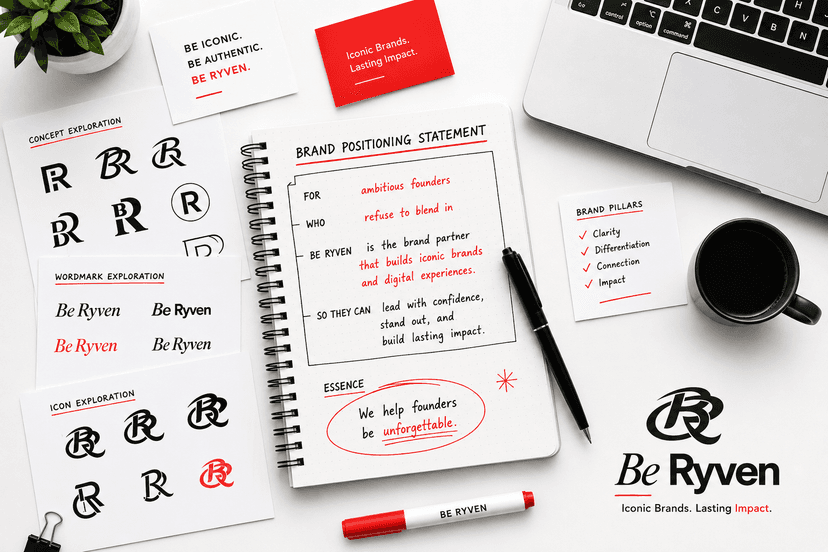
A logo is one output of brand identity. It is not the identity itself. Brand identity is the complete system: your strategic positioning, your tone of voice, your visual language and how all three stay consistent whether someone encounters you on a website, a pitch deck, an Instagram story or a printed business card.
The mistake almost every early-stage UAE founder makes is designing the logo first and the strategy never. A logo built before anyone has answered who the brand is for, what it stands for and why it's different has no foundation to stand on. It might look good in isolation. It can't do the actual job.
Strong Brand Identity Examples
Example #1 - Positioning Before Pixels
Think about the most recognizable consumer brands operating in the UAE today - the ones whose logo you could sketch from memory. None of them started with the logo. Apple's entire visual identity exists to communicate simplicity and precision, not the other way around. The visual language is downstream of a decision about what the brand is supposed to mean to people. For a UAE startup, this translates into a simple but uncomfortable exercise before any design work begins: write down, in one sentence, who this brand serves, what makes it different from the three closest competitors, and what feeling someone should have after one interaction. If you can't answer that clearly, no designer can build an identity that expresses it.
Example #2 - Bilingual Coherence, Not Just Translation
This is where UAE branding diverges sharply from branding playbooks written for single-language markets. The UAE operates across Arabic and English simultaneously and a name or visual mark that works beautifully in one language can land awkwardly, become difficult to pronounce, or carry an unintended meaning in the other. A brand identity example that handles this well doesn't treat Arabic as an afterthought translated once the English brand is finished. It considers both languages from the naming stage onward - testing how a wordmark reads in Arabic script, whether the tone of voice translates with the same warmth or formality and whether the visual system holds together in right-to-left layouts.
Example #3 - A System, Not a One-Off Design
A logo on its own can't carry a brand across every place it needs to show up: a website, a social feed, a pitch deck, a storefront, a product label. What makes an identity actually function is the system underneath it - a defined color palette with exact codes, a typography hierarchy, consistent graphic elements and clear rules for how the logo can and can't be used. Without that system every new application becomes a fresh creative decision made from scratch. The result, over time, is a brand that looks like it was assembled by three different designers who never spoke to each other - because functionally that's often what happened.
Example #4 - A Voice That Sounds Like One Person
Visual consistency gets most of the attention but tone of voice matters just as much and gets neglected far more often. Most UAE startups treat voice as something handled in the moment - whoever is writing the Instagram caption that day decides the tone and whoever drafts the next proposal decides a different one. The fix isn't complicated but it does require deliberate work: document your voice the same way you'd document your color codes. Define three or four adjectives that describe how the brand sounds write a few example sentences in that voice and treat it as a real brand asset rather than a writing preference.
Identity Built on Strategy vs. Identity Built on Aesthetics Alone
| Factor | Strategy-First Identity | Aesthetics-First Identity |
|---|---|---|
| Starting point | Positioning, audience, differentiation | Logo concepts and mood boards |
| Bilingual handling | Considered from naming stage | Translated after the fact |
| Consistency across channels | Built into a documented system | Decided case-by-case |
| Tone of voice | Documented and consistent | Varies by who's writing |
| Typical lifespan | Scales for years without a rebuild | Often redone within 12-18 months |
| Cost over time | Higher upfront, lower long-term | Lower upfront, expensive to redo |
A Real-World Pattern We See Often
Picture two early-stage SaaS startups launching in Dubai within the same quarter. Startup A spends two weeks on positioning before any visual work starts - defining who the product is for, how it's different from the two closest competitors and what the brand should feel like. The resulting identity is simple but every piece points in the same direction. Startup B skips straight to a logo design brief, likes a concept and builds outward from there.
Twelve months later, Startup A's brand has scaled cleanly across a new product line, an investor deck and an Arabic-language landing page without friction. Startup B is mid-rebrand because the original logo doesn't work in Arabic, the color palette clashes with their now-larger product suite and nobody documented why any of the original decisions were made. The visible cost of Startup A's approach was two extra weeks at the start. The cost of Startup B's approach is a six-figure rebuild eighteen months in. That's also when they realize they need a website rebuild to match the new branding.
Why This Matters More in Dubai Specifically
Dubai operates on a default expectation of premium positioning. If a brand doesn't communicate quality, clarity and credibility within the first few seconds of contact, the audience simply moves to the next option - and in a market this saturated, there's always a next option. The brands that succeed here feel intentional from the very first interaction and that feeling is the product of strategy work happening before the design work, not instead of it.
Actionable Takeaways
- •Before approving any logo concept, write a one-sentence positioning statement and test every design decision against it
- •If your audience is bilingual, involve Arabic consideration from the naming stage, not as a translation step at the end
- •Document three brand colors with exact hex codes, your typography choices and basic dos and don'ts before you need them - not after inconsistency has already crept in
- •Write down your tone of voice in a few sentences so anyone on your team can write in a way that sounds like the same brand
- •Treat brand identity as infrastructure for growth, not a one-time creative project
Frequently Asked Questions
Clear answers to help you make a confident decision.
A strong brand identity example is one where the visual design, tone of voice and positioning all stem from a clear strategic foundation - who the brand serves, what makes it different and what it should feel like - rather than starting with a logo design and working backward.